

GRAB MY FREE TRAINING
The No Leaks Funnel

GRAB MY FREE APP
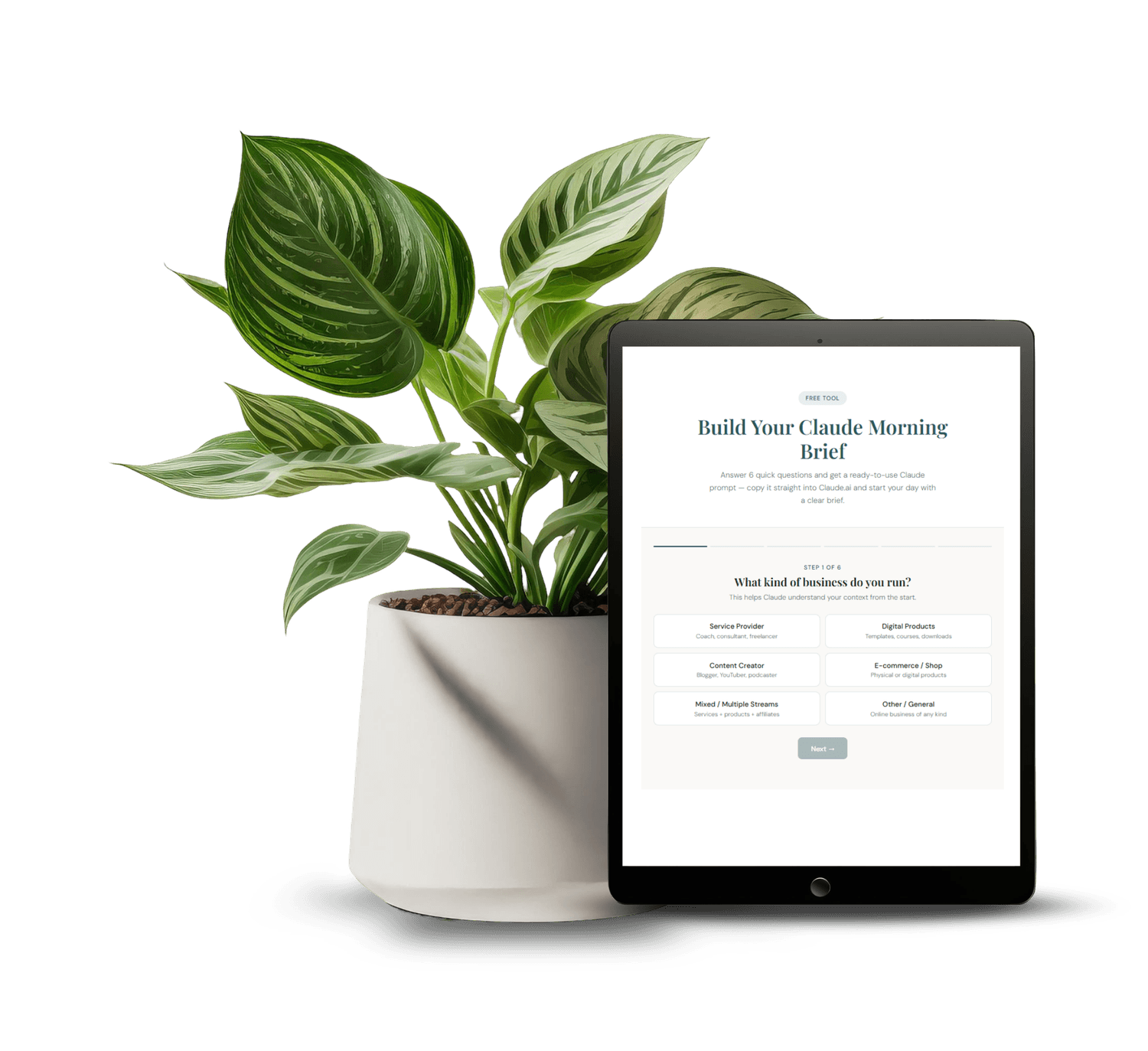
Morning Brief Claude AI Prompt
Set-up your custom morning brief for Claude

GRAB MY FREE APP
Income Allocator
Work out how to break down your income properly with percentages
The Airtable Setup Every Digital Product Seller Should Have in 2026
Airtable is one of those tools that's been in the "I should set that up properly" category for a lot of online business owners for years. It sounds complicated. The blank base is overwhelming. Most people open it, create a table, wonder what to put in it, and go back to their scattered notes app.
The Airtable setup that actually works for digital product sellers in 2026 isn't complicated. It's a handful of connected tables that give you one place to manage your products, your launches, your content, and your income without having to hold it all in your head.
This post walks through what that setup looks like and why each piece matters.
Why Airtable Works Better Than Notion for Running a Digital Product Business
Both Airtable and Notion get recommended for online business, and both can work. But Airtable's advantage is that it's a proper relational database. You can link a blog post record to the product it promotes, link that product to its funnel, and link the funnel to a launch record, all connected, all queryable.
Notion is more like a document system with database-ish features bolted on. It requires constant tweaking of how it looks and it doesn't scale the same way as your business gets more complex.
If you've been using Notion and it feels a bit fragile as your business grows, Airtable vs Notion for online business covers the comparison in more depth. But the short version is: if you're running a product-based online business with content, email, and launches, Airtable handles it better.
The Core Tables Every Digital Product Seller Needs
You don't need 20 tables. You need a small number of well-connected ones. The core set for a digital product seller is: Products, Content Hub, Blog Posts, Emails, Weekly Metrics, and a Launch Log.
Products is the anchor table. Everything links back to it. Content Hub is your idea library with angles, keywords, and publish dates. Blog Posts, Emails, and YouTube Videos connect to the Content Hub idea they came from and the Product they promote. Weekly Metrics is one record per week. Launch Log is one record per launch.
That's a complete picture of your business in six tables. Add more as you have a real need for them, not before.
Setting Up Your Products Table
Your Products table should have at minimum: product name, price, sales page URL, checkout URL, status (live, coming soon, archived), and a linked field to content that promotes it.
The linked field to content is the important one. Once you have it set up, you can open any product record and see every blog post, email, and video that links to it. When you want to run a launch, you can check what content already exists and what needs to be created.
Airtable is free to start with. The free plan handles this kind of setup without any restrictions that affect small online businesses. You don't need a paid plan until you have a much more complex database or multiple collaborators.
Your Content Hub: The Table That Runs Your Content
The Content Hub table is where every content idea lives before it becomes anything. One record per idea, with fields for: the topic, the angle, the primary keyword, the target audience, what product it promotes, what week it's scheduled for, and the status (idea, writing, published).
The Weekly Planning view shows everything assigned to the current week with status. That's your Monday morning starting point. No need to figure out what to write about, it's already in the table.
The other view that's useful is one filtered by "Idea" status, so you have a running list of things to write about when you're filling in the next few weeks. When you have a thought on a Tuesday, add it to the table. When you sit down to plan the week, pick from what's already there.
Connecting Your Content to the Products It Promotes
Every piece of content should link to the product it's designed to support. This isn't about turning everything into a sales pitch. It's about being intentional. If you're writing about how to plan a product launch, it should link to your launch system. If you're writing about Canva templates, it should link to something relevant.
That connection is what makes content work as a business asset rather than just a thing you published. Make is useful here if you want to automate certain parts of the content-to-product pipeline, like tagging blog post records when a product record is updated or creating linked records automatically. It's the only automation platform that also connects to Etsy, which is useful if Etsy is part of your sales mix.
Tracking Your Weekly Metrics in Airtable
One record per week in your Weekly Metrics table. Fields for: revenue, email subscribers, YouTube subscribers, Instagram followers, Pinterest monthly views, Google Search clicks, and impressions. Takes about five minutes to fill in on a Friday.
The value isn't in any single week. It's in the trend over time. After three months, you can see which content is actually driving traffic, which platforms are growing, and whether your income is moving in the right direction. Without that data, you're making decisions based on gut feel and recent memory, neither of which are reliable.
The best Airtable templates for online business owners include Weekly Metrics tracking as a core component for exactly this reason.
Adding a Launch Log to Track Every Launch
Every product launch gets one record in the Launch Log table. Fields for: product linked, launch type (evergreen or live), revenue target, actual revenue, launch dates, what worked, what you'd change next time.
The launch review is the part most people skip, and it's the part that makes every subsequent launch better. If you have a Launch Log record for every launch you've run, you can compare them, see patterns, and make smarter decisions about your next one.
Also useful: a Funnel Steps table that maps every step of your funnel for each product, with the URL and the conversion rate at each step. Once you have a few months of data, you can see exactly where people drop off and fix the right thing.
How to Build Your First Airtable Base From Scratch
If you're starting from zero, the most common mistake is trying to build everything at once. Start with just two tables: Products and Content Hub. Get those working and linked correctly, then add the others one at a time.
How to build your first Airtable base from scratch covers the setup process step by step. The key things to get right early: field types matter (a URL field is not the same as a text field), and linked record fields need to know which table they link to before you create them.
Give yourself one focused hour to set up the core tables. It's less time than it takes to keep recreating your product list in a Google Doc every time you need it.
Running Your Business From Airtable With Claude AI
Once your Airtable base is set up, the next level is using Claude AI to interact with it. Instead of opening Airtable and scrolling through records, you can ask Claude to pull the information you need, generate content based on what's in your tables, or update records based on your instructions.
This is what running a business from a proper database actually looks like in 2026. Not just a prettier spreadsheet, but a system that an AI can read, write to, and act on. The CEO Control Centre is a done-for-you Airtable system built for online business owners who want to run their business from one place. It includes a CEO Dashboard, project and task tracking, an automation register, and weekly metrics. The morning-brief Claude skill reads from it every day and delivers a prioritised briefing for the day ahead.
FAQ
Do I need a paid Airtable account to set this up?
No. The free Airtable plan is sufficient for a solo digital product business. You only need a paid plan if you have multiple collaborators or a very large number of records.
Can I migrate my current setup from Notion or a spreadsheet?
Yes. You can copy and paste data into Airtable or import from CSV. The main work is setting up the table structure and field types correctly. Once that's done, importing existing data is straightforward.
How is Airtable different from a regular spreadsheet?
The biggest difference is linked records. In a spreadsheet, you can reference another cell. In Airtable, you can link to a whole record in another table and see all its fields. That's what makes relational data possible without writing formulas.
What if I don't have many products yet?
Start with one product and build the content around it. The tables scale. A setup with one product works the same way as one with twenty. You're building the system now so you don't have to redo it later.
Does Airtable work on mobile?
Yes, there's an Airtable app for iOS and Android. It's useful for quick updates and checking records on the go, though the desktop version is better for setting up views and doing real work.
Disclaimer: This website may contain affiliate links. If you click a link and make a purchase, I may receive a small commission at no extra cost to you.
Disclaimer:
This website may contain affiliate links. If you click a link and make a purchase, I may receive a small commission at no extra cost to you.

About Liz Peck
Liz Peck helps online business owners build the backend that runs without them - using Airtable for operations, Systeme for sales, and Claude AI for the work you hate doing twice. lizpeck.com.au

Disclaimer:
This website may contain affiliate links. If you click a link and make a purchase, I may receive a small commission at no extra cost to you.