

GRAB MY FREE TRAINING
The No Leaks Funnel

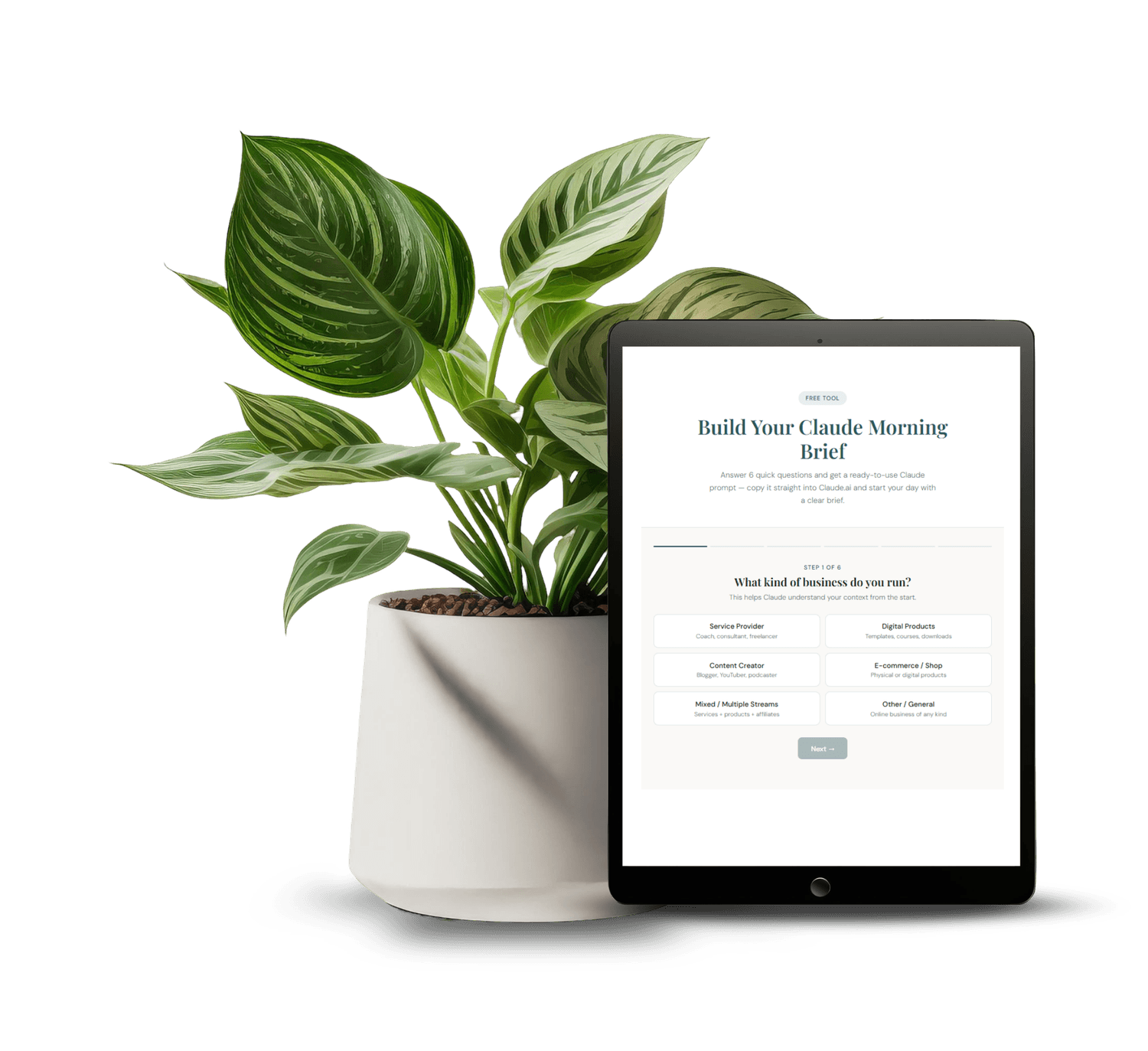
GRAB MY FREE APP
Morning Brief Claude AI Prompt
Set-up your custom morning brief for Claude

GRAB MY FREE APP
Income Allocator
Work out how to break down your income properly with percentages
Best Airtable Templates for Online Business Owners in 2026
The best Airtable templates for online business owners are the ones that link your products, finances, content, and tasks together in a single base. Instead of jumping between spreadsheets, project management tools, and note apps, everything lives in one connected system.
I've tested dozens of Airtable setups over the past two years. Most templates you'll find online are too generic or too complicated. Here's what actually works for running an online business.
Why Most Airtable Templates Miss the Mark
Most Airtable templates are built as standalone tables with no real connection between them. You get a task tracker, a content calendar, or a product list, but they don't talk to each other.
The problem with disconnected templates is that you end up doing the same data entry in three different places. You add a product to your product table, then separately log it in your revenue tracker, then mention it again in your content plan.
A well-built Airtable base for online business uses linked records to connect your tables. When you add a new product, it automatically shows up in your financial projections, your content schedule, and your task list. That's the difference between a template and an actual operating system.
The Airtable Product Tracker Template
The product tracker is the foundation of a good Airtable setup for online business. It's where you record every product you sell or plan to sell, with fields for product name, price, platform, status, and revenue.
The key is what you link to it. Your product tracker should connect to your income log so every sale automatically updates your revenue totals. It should also connect to your content table so you can track which products you're promoting in which posts.
Fields to include in your product tracker: Product name, Price, Platform (Etsy, Gumroad, Teachable, etc.), Status (Active, Draft, Retired), Launch date, Total revenue (linked from income log), and Content created (linked from content table).
The Airtable Income and Expense Tracker Template
Tracking money in a spreadsheet works until it doesn't. The problem with spreadsheets is that they require manual data entry with no connection to your actual products or invoices.
An Airtable income and expense tracker fixes this by linking directly to your product table. When you log a sale, you select the product from a dropdown (which pulls from your product table), and the revenue automatically flows into your financial summary.
Your income table should have: Date, Amount, Product (linked to product tracker), Platform, Payment method, and Month (formula field). Your expense table should have: Date, Amount, Category, Vendor, Receipt (attachment), and Tax deductible (checkbox).
The Airtable Content Calendar Template
A content calendar in Airtable is more useful than one in Notion or a Google Sheet because you can link each piece of content directly to the product it promotes. This means your content calendar becomes a strategic tool, not just a list of post ideas.
Your Airtable content calendar should include: Post title, Platform (Instagram, Pinterest, Blog, Email, etc.), Status (Idea, In Progress, Scheduled, Published), Publish date, Product promoted (linked to product tracker), Content type (educational, promotional, behind the scenes), and Notes.
Add a gallery view filtered by Platform to see all your Instagram content in one place, and a calendar view filtered by Status = Scheduled to see what's going out this week.
The Airtable Task Manager Template for Online Business
Most task managers treat tasks as individual items with no context. Airtable lets you link tasks to the specific product launch, content piece, or project they belong to.
Your task table should have: Task name, Status (To Do, In Progress, Done), Due date, Priority (High, Medium, Low), Project or product (linked field), Assigned to (if you have a team or VA), and Notes.
The most useful view for daily work is a grid filtered to Status = In Progress or To Do, sorted by Due date. Create a separate view for each product launch so you can see all the launch tasks in one place without scrolling through everything else.
The Airtable Client and Customer Tracker Template
If you sell services, do coaching, or have any ongoing client relationships, a client tracker in Airtable will save you significant time each week. Unlike a CRM that's built for sales teams, an Airtable client tracker is built around your specific workflow.
Fields to include: Client name, Email, Service purchased, Start date, End date or renewal date, Status (Active, Completed, Paused), Total paid, and Notes.
Link your client table to your income table so you can see exactly how much each client has paid. Link it to your task table so every client has their own set of tasks and nothing falls through the cracks.
The Airtable Launch Planner Template
A launch planner in Airtable is a dedicated table (or a filtered view of your task table) for managing all the moving parts of a product launch. When you launch a digital product, there are typically 30 to 50 tasks across content, tech setup, email marketing, and social media.
Your launch planner should include: Launch name, Product being launched, Launch date, Phase (Pre-launch, Launch week, Post-launch), Task, Owner, Status, and Due date.
Use a grouped view grouped by Phase so you can see exactly what needs to happen in each stage of the launch. Set up a formula field that calculates days until launch so you always know how much runway you have.
How to Connect Your Airtable Tables Without Breaking Everything
The most powerful feature in Airtable is linked records, and it's also the one that trips people up the most. Here's the simplest way to think about it: linked records work like a dropdown that pulls from another table.
When you create a linked record field in your income table that links to your product table, you're not duplicating data. You're pointing to a record that already exists. This means if you update a product's price in the product table, the income table automatically reflects it.
Start simple: link your product table to your income table first. Get comfortable with how rollup fields and lookup fields work. Then add the content table link, then tasks. Build one connection at a time rather than trying to build the whole system at once.
Which Airtable Plan Do You Actually Need
The free Airtable plan is surprisingly capable. You can have unlimited bases with up to 1,000 records per base on the free plan. For most online business owners starting out, this is enough to build a fully functioning business operating system.
You'll want to upgrade to the Plus or Pro plan when you have more than 1,000 records in any table, when you need more than 5 editor seats, or when you want access to advanced features like field types, Gantt charts, or automations.
Most solo online business owners can run their entire business on the free plan for the first 12 to 18 months. Start free, build your system, then upgrade only when you actually hit a limitation.
FAQ
Are Airtable templates free?
Airtable has a template gallery with free options. My templates are paid products that include pre-built structures specifically for online business owners. Airtable itself has a free plan with 1,000 records per base.
Can I customise an Airtable template after I install it?
Yes. Templates are starting points. You can add fields, remove fields, create new views, and adjust the structure to fit how you work.
Do I need to be technical to use Airtable templates?
No. If you can use a spreadsheet, you can use Airtable. The main concept to learn is linking records between tables, which makes sense quickly once you try it.
How many templates should I start with?
One. Pick the area that causes you the most friction and start there. Add more templates or tables as the need becomes clear.
Can I connect Airtable to other tools?
Yes. Airtable connects to Make, Zapier, and has its own built-in automations. You can automate record creation, send notifications, and trigger actions in other tools when records change.
Disclaimer: This website may contain affiliate links. If you click a link and make a purchase, I may receive a small commission at no extra cost to you.
Disclaimer:
This website may contain affiliate links. If you click a link and make a purchase, I may receive a small commission at no extra cost to you.

About Liz Peck
Liz Peck helps online business owners build the backend that runs without them - using Airtable for operations, Systeme for sales, and Claude AI for the work you hate doing twice. lizpeck.com.au

Disclaimer:
This website may contain affiliate links. If you click a link and make a purchase, I may receive a small commission at no extra cost to you.