

GRAB MY FREE TRAINING
The No Leaks Funnel

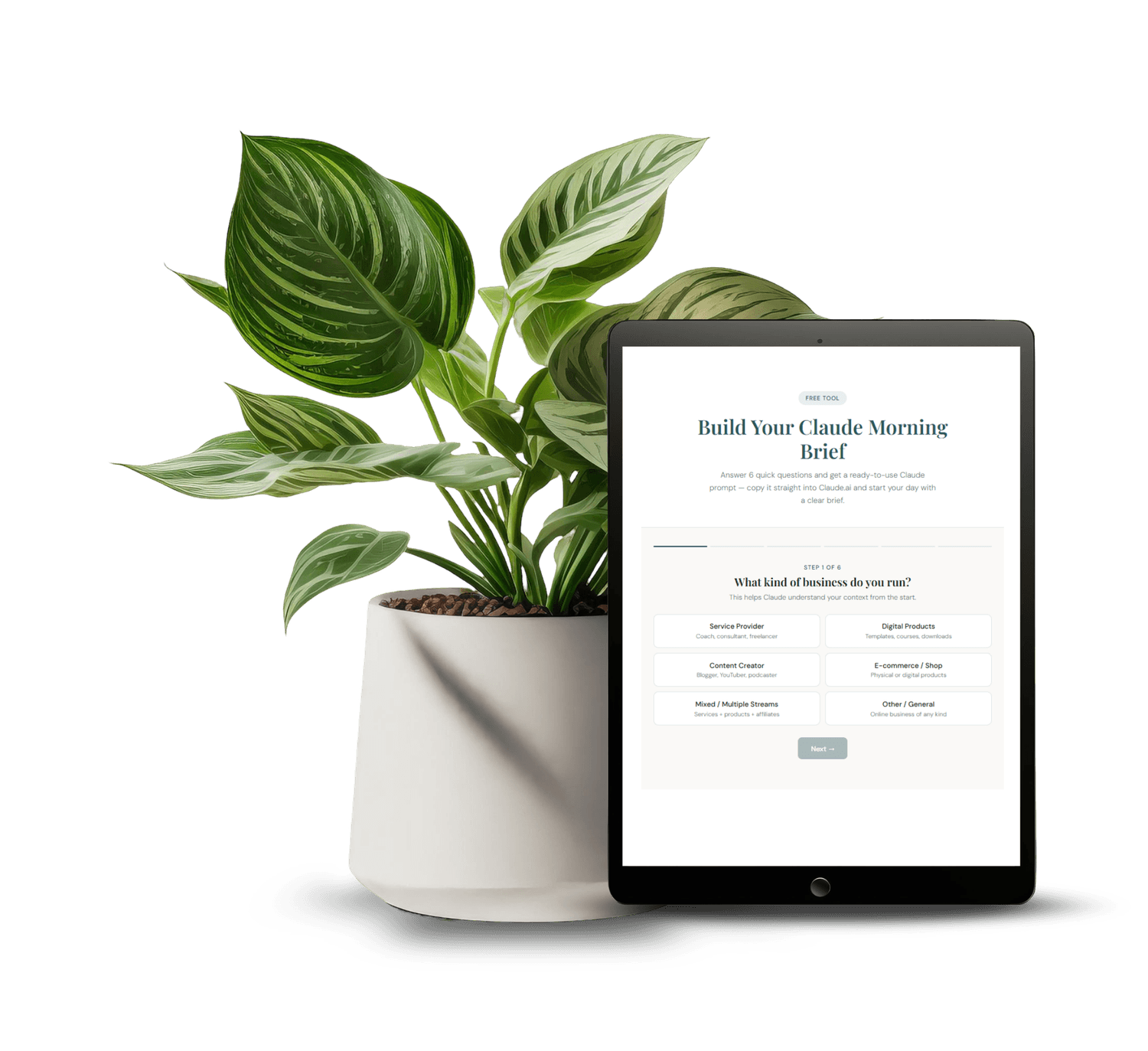
GRAB MY FREE APP
Morning Brief Claude AI Prompt
Set-up your custom morning brief for Claude

GRAB MY FREE APP
Income Allocator
Work out how to break down your income properly with percentages
How to Handle Customer Support as a Solo Digital Product Seller
Why Customer Support Gets Messy When You're Solo
Customer support as a solo digital product seller doesn't need to be complicated. The simplest approach is to follow up on every order, give customers a clear way to ask for help, and track those requests in one place so nothing falls through the cracks.
Most people don't realise how much support issues drain their energy until they're deep in a messy inbox full of DMs, emails, and half-answered questions. Here's how I handle it without it taking over my week.
When you're running everything yourself, support requests show up everywhere. Facebook DMs, Instagram messages, email replies, Etsy conversations. There's no single place to see what's been handled and what hasn't.
This is usually where people start feeling overwhelmed. It's not that the volume is high. It's that every support request requires context switching. You have to figure out what they bought, what the issue is, what you've already said, and then write a thoughtful reply.
That mental load adds up fast. I've noticed that the support itself isn't what burns people out. It's the friction around it. Not knowing if you've replied. Losing track of a conversation. Realising three days later that someone's still waiting.
Following Up on Orders (And Why It Matters)
One thing I started doing early on was following up with customers after they purchase. Not a generic thank you email. An actual check-in.
Something like: "Hey, just checking in. Have you had a chance to use [product name]? If you run into anything or need help getting started, here's a link to submit a support request."
This does a few things at once. It shows you care about their experience. It gives them a clear path to get help if they need it. And it catches problems early before they turn into negative reviews or chargebacks.
You can set this up as an automated email through a platform like Systeme so it goes out a few days after purchase without you having to remember.
Getting Support Requests Out of Your DMs
This is the biggest shift I made. Instead of letting support live across five different platforms, I created one place for it.
I built a simple helpdesk form. When someone needs help, they click a link (from the follow-up email, or from a help page on my site), fill in the form, and it creates a ticket.
That ticket goes straight into my Airtable base. I can see the customer's name, email, what product they bought, and what the issue is. All in one row.
No more scrolling through DMs trying to remember if I replied. No more searching my inbox for that one email from last Tuesday. Everything is in one place, and I can see at a glance what needs attention.
If you're not using Airtable yet, it's worth looking at. It works like a database but it's visual and easy to set up without any technical knowledge.
Setting Up a Simple Helpdesk System
You don't need expensive helpdesk software to make this work. Most solo sellers can set up something functional in an afternoon.
Here's what mine looks like:
A simple form (I use a Systeme form) that collects the customer's name, email, product purchased, and a description of their issue. That form submission creates a record in an Airtable table. The table has columns for status (new, in progress, resolved), priority, and any notes I add. I check it once or twice a day and work through the open tickets.
The form link goes in my order follow-up emails, on my website help page, and anywhere else a customer might look for support.
Most people build their systems too complicated. You don't need a full Zendesk setup. You need a way to see what's been asked and whether you've replied. That's it.
If you want a done-for-you version of this exact setup, I built a Helpdesk OS system that includes the Airtable base, ticket tracking, message threads, and even a Claude AI skill that helps draft replies based on your product documentation.
Using AI to Help You Reply Faster
This is where things get interesting. Once your support tickets are in Airtable, you can connect Claude AI to help draft responses.
Here's how it works in my setup: Claude reads the ticket, looks up the relevant product documentation, and writes a draft reply. I review it, maybe tweak a sentence, and send it.
Before I set this up, writing support replies was the task I'd procrastinate on most. Not because it was hard, but because it required so much mental energy to context switch into each customer's specific situation.
Now the draft is already there when I sit down to work through tickets. Most of the time it's accurate enough to send with minimal changes.
If you're curious about how Claude works as a business tool beyond just support, I wrote about the real use cases I rely on in my post on using Claude AI for your online business.
Tracking Recurring Issues to Improve Your Products
Here's something most people miss. Your support tickets are data.
If the same question comes up three times, that's not a support problem. That's a product problem. Or at least a documentation problem.
When I started tracking tickets properly, patterns became obvious. One product had a confusing download process. Another had a step that people kept getting stuck on. Once I could see those patterns clearly, I fixed the root cause and the support volume dropped.
This is why having tickets in a system matters more than just replying faster. You can actually see what's going wrong and fix it.
Businesses that feel calm outperform chaotic ones long-term. And a lot of that calm comes from catching small problems before they multiply.
What Good Support Looks Like (Without Spending All Day On It)
The goal isn't to be available 24/7. It's to have a process that works without you having to hold it all in your head.
Check tickets once or twice a day. Batch your replies. Use templates for common questions. Let AI handle the first draft.
When the system is set up properly, support becomes a 15-20 minute task instead of an all-day anxiety source. That's the difference between a system and just reacting to whatever comes in.
I know some people worry that using templates or AI for support feels impersonal. But honestly, a fast and accurate reply is better than a handcrafted one that takes three days. Customers care about getting their problem solved. They don't care how long you spent writing the email.
The Pros and Cons of Different Support Approaches
To be fair, there's no single right way to handle this. Here's what I've seen work and not work:
DMs and email only (no system):
- Pro: Zero setup required
- Con: Things get lost constantly, you can't track patterns, and it eats your mental energy
Basic form + spreadsheet:
- Pro: Simple, free, and gets requests into one place
- Con: Manual tracking, no automation, you outgrow it quickly
Airtable helpdesk (what I use):
- Pro: Visual, flexible, connects to AI and automations, scales with your business
- Con: Takes an afternoon to set up (or you can grab a done-for-you system)
Full helpdesk software (Zendesk, Freshdesk, etc.):
- Pro: Built for support at scale, lots of features
- Con: Overkill for most solo sellers, expensive, complex to configure
For most people selling digital products on their own, the Airtable approach hits the sweet spot. Powerful enough to actually help, simple enough that you'll use it.
FAQ's
Do I need to respond to support tickets every day?
Not necessarily. Once or twice a day is fine for most digital product businesses. What matters more is consistency. If customers know they'll get a reply within 24 hours, that's better than sporadic fast replies followed by days of silence.
Can I use AI to reply to customers without them knowing?
You can use AI to draft replies, but you should always review them before sending. AI gets the tone and content right most of the time, but it can occasionally get details wrong. Think of it as a first draft, not an auto-responder.
What if I only get a few support requests per month?
Even with low volume, having a system matters. It takes five minutes to check a ticket board versus twenty minutes of context switching across DMs and emails. And when your volume grows, the system is already in place.
How do I set up a helpdesk in Airtable?
I have a detailed walkthrough in my post on setting up a helpdesk in Airtable with Claude AI. The short version: create a table with fields for customer info, issue description, status, and priority. Add a form view for customer submissions. Connect Claude for draft replies if you want the AI layer.
Disclaimer:
This website may contain affiliate links. If you click a link and make a purchase, I may receive a small commission at no extra cost to you.

About Liz Peck
Liz Peck helps online business owners build the backend that runs without them - using Airtable for operations, Systeme for sales, and Claude AI for the work you hate doing twice. lizpeck.com.au
Disclaimer:
This website may contain affiliate links. If you click a link and make a purchase, I may receive a small commission at no extra cost to you.