

GRAB MY FREE TRAINING
The No Leaks Funnel

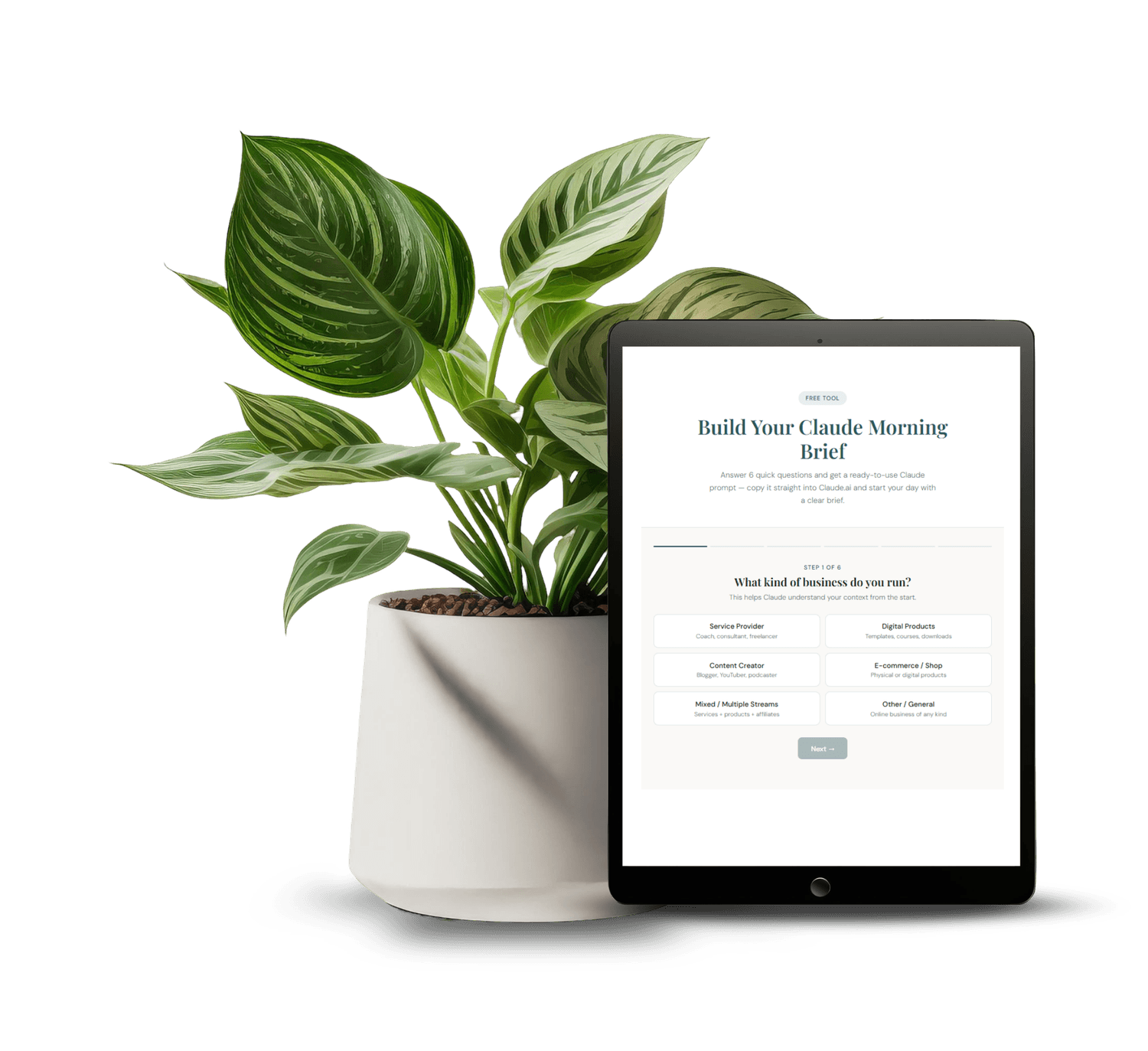
GRAB MY FREE APP
Morning Brief Claude AI Prompt
Set-up your custom morning brief for Claude

GRAB MY FREE APP
Income Allocator
Work out how to break down your income properly with percentages
What Is a Claude Skill and How Do You Build One?
How I Think About Claude Skills
A Claude skill is essentially a saved set of instructions that tells Claude how to complete a specific task. Think of it like a standard operating procedure that Claude follows every time you ask it to do that task. Once you save a skill, Claude remembers the process and can repeat it consistently without you having to explain it again.
If you've ever found yourself giving Claude the same instructions over and over, that's exactly where skills come in.
The easiest way to understand a skill is to compare it to how you'd train someone new. If you hired a virtual assistant, you wouldn't explain the same task from scratch every single time. You'd write it down, hand them the document, and say "follow this."
That's what a skill does for Claude. It's the written process that Claude references whenever you trigger that task.
In my business, I have skills for things like processing invoices, running my morning brief, publishing blog posts, and drafting helpdesk replies. Each one started as something I was doing manually with Claude, explaining step by step what I needed. Once I got the process right, I saved it as a skill so I never had to explain it again.
What a Skill Actually Looks Like
A Claude skill is a markdown file that contains instructions. It typically includes:
A description of what the task is and when to trigger it. Step-by-step instructions for how to complete the task. Details about which tools or data sources to use. Rules and edge cases to handle.
For example, my invoice processor skill tells Claude to read an invoice image, extract the vendor name, date, amount, and category, then log it to my Expenses table in Airtable with the receipt attached. The skill file contains every field ID, every rule about categorisation, and how to handle different invoice formats.
Without the skill, I'd have to explain all of that every time I dropped an invoice into the conversation. With the skill, I just drop the invoice and it handles everything.
How to Build Your First Skill
The simplest way to create a skill is to start by doing the task with Claude manually. Walk through it step by step. Give Claude all the context, all the instructions, all the specific details about how you want it done.
Once you're happy with the result, ask Claude to save that process as a skill. You can say something like "save this as a skill so you can do it again next time."
Claude will create a skill file with the instructions. You can then add this skill to your Claude setup under customise/skills. From that point on, whenever you ask Claude to do that task, it follows the saved instructions.
Here's what I've found works best:
Start with a task you do regularly. Something you find yourself explaining to Claude more than twice. Do the task once with Claude, giving it all the detail it needs. Review the output and refine the instructions if anything was off. Then save it as a skill.
The first version doesn't need to be perfect. You can update skills at any time. I've revised most of mine at least a few times as I noticed edge cases or found better ways to handle certain steps.
What Makes a Good Skill vs a Bad One
A good skill is specific and detailed. It doesn't leave room for interpretation on the important parts. It tells Claude exactly what to do, where to get data, and how to format the output.
A bad skill is vague. Something like "help me with my emails" isn't a skill. "Read my unread emails, categorise them into action required, FYI, and invoices, draft replies for action items in my voice, and log any invoices to Airtable" is a skill.
The difference is that a specific skill produces consistent, reliable results. A vague one produces different output every time.
I've noticed that most people use AI wrong because they stay on the chat side of things instead of building repeatable processes. Skills are what bridge that gap. They turn Claude from a chatbot into an actual working layer of your business.
Skills I Use Every Day
To give you a sense of what's possible, here are the skills that run in my business regularly:
Morning brief: Pulls data from my Airtable, calendar, and email, then gives me a structured daily brief with what's due, what's overdue, and what needs attention.
Invoice processor: Reads invoice images, extracts the details, and logs them to my Expenses table in Airtable automatically.
Blog publisher: Writes, builds, and publishes a complete blog post on my site including SEO settings and Google indexing.
Helpdesk AI: Reads support tickets, matches them to product documentation, and drafts contextual replies.
Daily email assistant: Summarises my inbox, drafts replies, and captures invoices.
Each of these started as a manual process. I did it with Claude a few times, refined the instructions, and saved it as a skill. Now they run with minimal input from me.
Where Skills Live and How to Manage Them
In Claude, skills are stored as files. You can access them under the customise section, where you'll find a skills area. You can enable or disable any skill at any time.
If you're using Claude Code or Claude Cowork, skills can also be stored as local files on your computer. This gives you more control over editing and versioning them.
You can update a skill whenever you want. If something changes in your workflow, just open the skill file, make the edit, and save it. Claude will use the updated version next time.
You can also disable skills you don't need anymore without deleting them. This is useful if a process changes seasonally or if you're testing a new approach.
The Honest Downsides of Skills
Skills aren't magic. Here are the things I've run into:
They take time to set up properly. The first version is rarely perfect, and you'll spend time refining. If your process changes, you need to update the skill or it will do things the old way. Complex skills that involve browser automation can be slow. Sometimes it's genuinely faster to do the task yourself than wait for Claude to work through it.
I've found that the sweet spot is tasks that are repetitive, follow a consistent process, and involve data you'd rather not handle manually. If a task is different every time or requires a lot of creative judgment, a skill might not be the right fit.
How Skills Connect to Your Business Systems
Skills become genuinely powerful when they connect to your existing tools. In my setup, most skills interact with Airtable because that's where my business data lives.
If you're not already using a system like Airtable to track your business operations, skills won't have much to connect to. The combination is what makes it work. Airtable stores and organises the data, and Claude skills act on it.
If you want to see how I use Claude as a full business tool, I wrote about the specific use cases in my post on using Claude AI for your online business. And if you're curious about how the helpdesk skill works in practice, I covered that in my post on setting up a helpdesk in Airtable with Claude AI.
FAQ
Do I need a paid Claude account to use skills?
The basic chat version of Claude doesn't support custom skills. You need Claude Pro or Claude Code/Cowork to create and use saved skills. Claude Pro is around $20 USD per month.
Can I share skills with other people?
Yes. Skills are just text files, so you can share them. The other person would need to adjust any specific details like Airtable base IDs or field IDs to match their own setup.
How many skills can I have?
There's no hard limit. I have over a dozen active skills. The practical limit is more about keeping them organised and updated than any technical restriction.
What's the difference between a skill and a prompt?
A prompt is a one-time instruction. A skill is a saved, reusable set of instructions that persists across conversations. Think of prompts as asking a question and skills as handing over a procedure manual.
Do I need to be technical to create skills?
No. If you can describe a process step by step, you can create a skill. The language is plain English, not code. That said, skills that connect to tools like Airtable do require knowing things like table names and field IDs, which takes a bit of setup.
Disclaimer:
This website may contain affiliate links. If you click a link and make a purchase, I may receive a small commission at no extra cost to you.

About Liz Peck
Liz Peck helps online business owners build the backend that runs without them - using Airtable for operations, Systeme for sales, and Claude AI for the work you hate doing twice. lizpeck.com.au
Disclaimer:
This website may contain affiliate links. If you click a link and make a purchase, I may receive a small commission at no extra cost to you.